
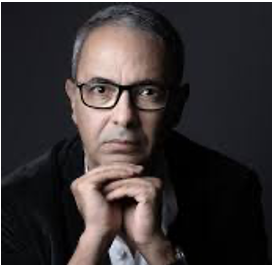
Thank you, dear Sirs [and Madams],
What to say? I am very happy to receive the Stig Dagerman Award. This Swedish literature prize highlights authors, or voices, who safeguard freedom of speech and are devoted to a fair-minded understanding of what an epoch hides or reveals. For me this prize outweighs years of grief, some mixed with joy, following my exile from Algeria. It offers consolation and infuses new life into my writing, that I hope will find an audience also in Sweden. Writing to me is inseparable from several other acts: the wish to live intensely; to bear witness to the rejection of wrong-doing; to love the world for the meaning it holds and the humor it contains, making life easier to bear, as in a dance. It is about containing within oneself, in ways both intimate and vulnerable, the tragedies of the times in which we live as well as the obligation to hold on to hope, at least for the sake of our children. In brief, I am happy and deeply moved to receive this award. The spirit of Stig Dagerman, a Swedish writer committed to social justice, individual responsibility and clear-seeing, seeks in me – as I humbly and perhaps clumsily accept – someone to follow in the footsteps of the work of this great predecessor.
Writing takes on a strange meaning when one lives caught between a country under dictatorship, Algeria, and another country, France, burdened by regret. During my whole life I have sought to liberate myself from both my own country’s “liberators”, those who profiteered on the memory of decolonization, as well as from the convenient amnesia of France, a country I love. Writing became for me an act of healing, a way to preserve my love of life, if only in the form of an insistent intention. It is an isolated art form. It is not easy, from the moment of birth, to be given the role of the victim of colonization, or the role as a spokesperson for victims of the guilt of former colonists. It is not easy to speak for every individual, about their vulnerability, their weaknesses, their will to life. It has to be done without deviating from the challenge to above all be the guardian of memory before seeking the right to happiness.

In all honesty, I don’t know If I deserve the prizes I receive, even if my vanity sometimes silently demands them, and I doubt that I truly or completely deserve them. To receive the Stig Dagerman award today forces me to at least try to prove that I will be worthy, one day, in all humility. I accept it less as a reward than as an added responsibility: to continue to write with power, honesty and courage.
Our times are dangerous: maybe not as dangerous as those in which Stig Dagerman lived, marked by WWII and its ravages, but they have this bitter quality: seemingly favoring denial, simplification and radicalism, alongside inhumanity. It is exactly this quality that literature strives to shed a light on. In my home country, Algeria, we live in-between a memory dictatorship and a refusal to live in the name of the dead. I have learned that literature offers the last refuge where truths from a bygone era find shelter, so that they still can be conveyed …
The old tale about the little girl with the match-sticks expresses this with great poignancy: every time she lights a match a flickering flame illuminates her world, revealing beauty, warmth and a dreamlike enchantment. But to us, onlookers and readers, the same light also reveals something else: It shows the unhappy girl’s fate, her short-lived joy, her vulnerability, and our own position in the face of this sad state of affairs. As the story ends, we ourselves become witnesses and there is no longer a way to avoid responsibility. Such is literature: it consoles, but foremost it forces each and every one of us to confront that which we rather leave in the shadows.
Thank you jury members and all of you for the confidence and the honor you have shown me by awarding me this prize. I am happy to confirm my presence at the reception of the award and participation in the ceremony.
Kind regards,
Kamel Daoud